SAILMENTOR
Learn the ropes — sailing skills, seamanship, and the calculators every sailor needs.
From sizing up your hull speed and sail area to resolving the true wind, setting the right anchor scope, reading the tide, and measuring the miles ahead, SailMentor pairs free hands-on sailing calculators with practical seamanship guides and a richly illustrated museum. Learn the ropes, sail further.
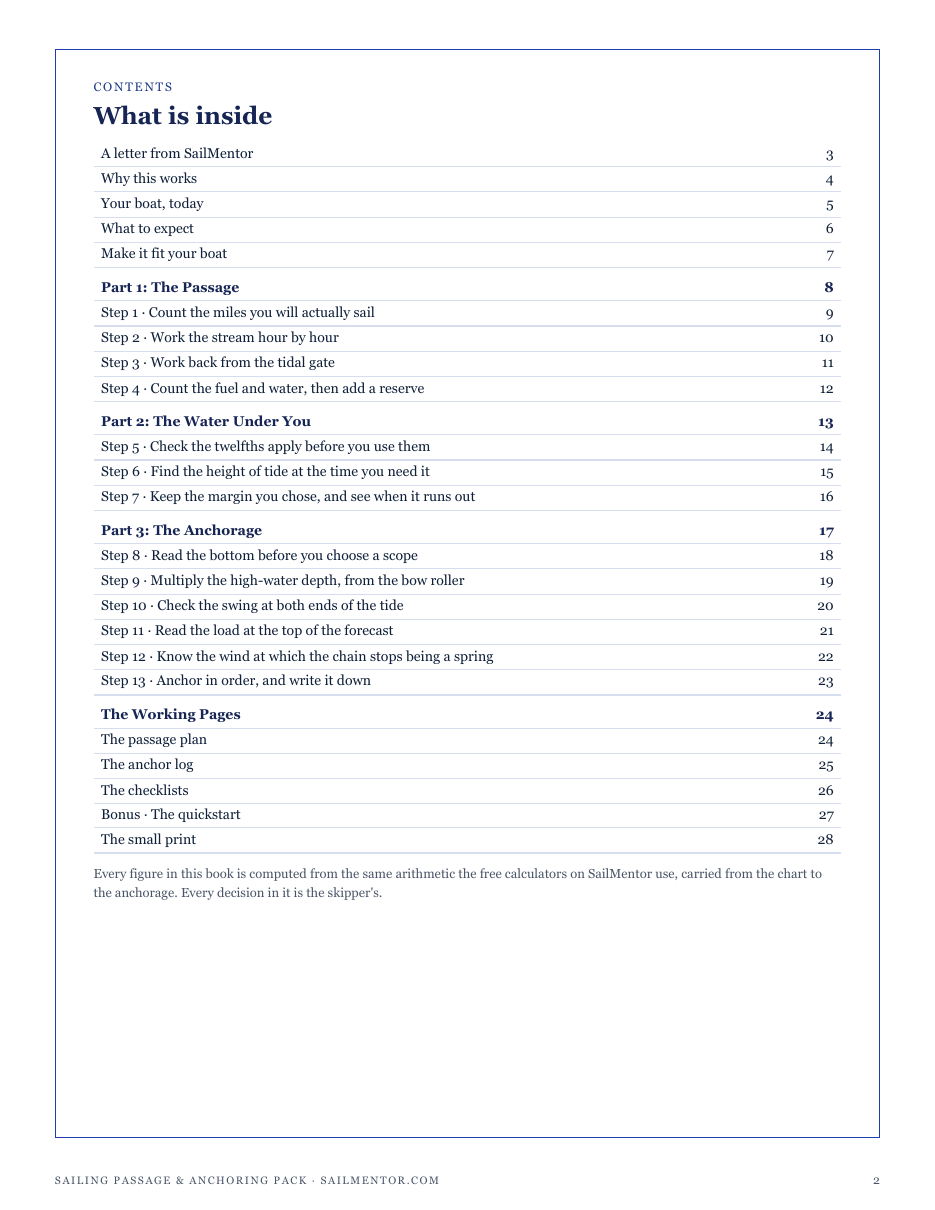
Sailing Passage & Anchoring Pack
Anchoring, under-keel clearance and passage planning
$4.99 · 28 printable pages — see what is in it →Sailing Tools & Calculators
Free tools for every passage — hull speed calculator, sail area calculator, true wind calculator, anchor scope calculator, tide height calculator, and sailing distance calculator.
⛵ Hull Speed Calculator
Find a displacement hull's theoretical top speed from its waterline length — hull speed in knots, mph, and km/h, using the classic 1.34 × √LWL rule
🌊 Sail Area Calculator
Work out mainsail and foretriangle area from your P, E, I, and J rig dimensions, then the total sail area and the sail-area/displacement ratio that gauges a boat's power
💨 True Wind Calculator
Turn the apparent wind on deck into the true wind over the water from your boat speed and apparent wind angle — true wind speed in knots and angle in degrees
⚓ Anchor Scope Calculator
How much rode to pay out for a secure hold: enter water depth, bow-roller height, and tidal rise, pick your scope ratio, and get the rode length in feet and metres
🌊 Tide Height Calculator
Estimate the water level between high and low water with the sailor's rule of twelfths — enter the two heights and the hours into the tide to see how far it has fallen
🧭 Sailing Distance Calculator
Measure a great-circle passage between two waypoints in nautical miles, kilometres, and statute miles, then estimate passage time from your average boat speed
Beat or Motor Calculator
Beating costs you distance and the engine costs you fuel: enter the leg, the wind and your tacking angle to get the real miles sailed, the time each way, and the speed under power above which motoring simply gets you there sooner
Ships & Seamanship Museum
Step into an immersive museum of the world of sail — the sailboats and rigs that catch the wind alongside the legendary ships of the age of sail, the gear and craft of seamanship and navigation, and the winds, weather, and great races that test every sailor, each in its own gallery, so you can get to know the stories behind every vessel and skill: how each one came to be, what makes it matter, and the part it plays in the enduring art of sailing.
Tour the museum →From the Journal
Fresh guides on sailing basics, seamanship, navigation, anchoring, weather, and boat maintenance, plus practical tips for trimming sails, reading the tide, and making the most of every passage.
Coastal Navigation Basics: Charts, Buoys, Compass and Fixes
Coastal navigation means knowing where you are, where the dangers are and how to get past them. This guide covers reading a chart, buoys and marks, the compass, taking a fix, dead reckoning and estimated position, the logbook, and using GPS with a paper backup.
How to Plan a Sailing Passage: Distance, Tide, Weather and Crew
A passage plan answers four questions before you leave: how far you will really sail, when the tide lets you go, whether the weather allows it, and what you will do if it goes wrong. This guide works through each step with examples.
The COLREGs Explained: Collision Rules for Sailors
The collision regulations decide who keeps clear on the water, and a sailboat does not always have right of way. Here are the rules a sailor meets most, in plain words.
How to Trim Sails: Telltales, Sheets and Sail Controls
Telltales show you what the air is doing on each sail, and a few controls change the sail's angle and shape. Here is what each one does, how to read the telltales, and the order to depower in when the wind builds.
How to Tack and Gybe: Calls, Helm and Sheets Step by Step
A tack turns the bow through the wind; a gybe turns the stern through it and swings the boom across the boat. Here are the calls, the helm and sheet work step by step, and how to keep the boom from catching anyone.
Preparing to Sail Offshore: Boat, Crew, Safety and Watches
Offshore, help is hours or days away, so the boat and crew must look after themselves. This guide covers preparing the boat, staying attached to it, watches and fatigue, communications and beacons, training, and the extra problems of sailing short-handed or alone.
Keep Learning
Practical know-how on rigging, sail trim, and anchoring, plain-language explainers on hull speed, true wind, and the rule of twelfths, and seasoned tips for new sailors and seasoned skippers alike — everything you need to dig deeper and sail further.
Visit the Learn hub →